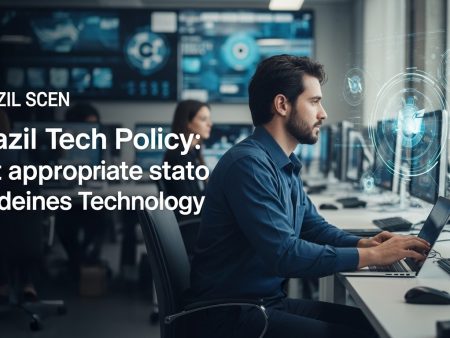
tech Technology Brazil: An in-depth, practice-oriented look at how Brazil’s tech landscape is evolving, balancing platform accountability, startup.
Brazil’s technology scene stands at a crossroads, highlighting how tech Technology Brazil shapes everyday life and long-term competitiveness. As regulators, investors, and users grapple with rapid AI adoption and data governance, the country is recalibrating its digital backbone—from startup funding to platform accountability. This analysis traces the threads binding policy, business strategy, and consumer trust, and imagines how Brazil can translate rapid tech progress into durable, inclusive growth.
Policy, platforms, and the responsibility question
Brazilian regulators and courts are increasingly asked to define the edges of platform responsibility in an age of AI-generated content, targeted advertising, and digital scams. Recent reporting describes instances where a major platform pursued legal action against advertisers tied to celebrity deepfake scams in Brazil and other markets, underscoring a broader concern: how to constrain misuse without choking innovation. For Brazilian policymakers, the challenge is twofold: protect consumers from deceptive exposure and bad actors while preserving a fair, accessible advertising ecosystem that supports local creators and small businesses. The implications extend beyond blocking harmful content; they shape the risk calculus for fintechs, e-commerce players, and new media ventures that rely on trust, identity verification, and auditable data trails. The outcome will likely hinge on concrete enforcement mechanisms, clear definitions of unlawful manipulation, and proportional penalties that deter abuse without deterring legitimate experimentation with AI and media formats.
In this context, Brazil’s data-protection regime and privacy norms become a central axis. Rules around data localization, cross-border data flows, and consumer consent influence how Brazilian startups design AI services and how international platforms operate locally. The regulatory environment is moving toward greater transparency in algorithmic decision-making, with a clear expectation that platforms cannot obfuscate their impact on end users. The practical effect for technology firms is a calibration of product design—favoring explainable AI, user-friendly opt-outs, and robust verification processes—so that Brazilian users retain confidence in digital services while developers maintain velocity in a highly competitive regional market.
Startup resilience and the Brazil market
Brazil’s tech ecosystem has shown a pattern of resilience: startups that combine local market insight with scalable business models tend to weather macroeconomic sensitivity better when they anchor themselves in multi-segment verticals—fintech, healthtech, agritech, and education technology. Access to capital remains uneven, but public and private programs at the federal and state levels have aimed to de-risk early-stage ventures, supporting proof-of-concept work and accelerator pipelines. In practice, this translates into stronger founder networks, more mature technical talent pipelines from Brazilian universities, and a sober focus on unit economics even as the country experiments with consumer-centric platforms and enterprise solutions. The Brazilian market’s unique mix of large, digitally engaged urban populations and dispersed regional players increases the importance of localization—language, payment rails, and logistics must be stitched into a single user experience to scale regionally within Brazil and into neighboring markets.
Beyond consumer apps, the industrial side of tech is accelerating. The energy, agriculture, and manufacturing sectors are increasingly digitized, with data-driven operations, remote monitoring, and predictive analytics driving efficiency gains. Startups that can bridge the gap between cutting-edge AI capabilities and real-world operational use cases—without requiring prohibitively expensive infrastructure—are well positioned to attract both local customers and international partners seeking a foothold in Latin America. The policy environment, while tightening on data governance, is also gradually creating channels for innovation, provided that compliance costs are manageable and that small players can participate in formal procurement and licensing processes.
The AI frontier: trust, adoption, and infrastructure
Artificial intelligence is moving from a lab curiosity to a core architectural layer for many Brazilian services. From consumer apps to industrial automation, AI promises productivity gains, personalized services, and new business models. Yet adoption hinges on trust: users must feel protected when sharing data, and enterprises must have clear governance over how AI models access, process, and store information. Infrastructure remains a practical bottleneck in some regions, where high-speed connectivity and reliable energy supply are not universal. Public investment in data centers, edge computing resources, and secure cloud partnerships can help bridge the gap, enabling lower-latency AI-enabled services in urban centers while remote areas gain access to digital tools that boost health, education, and commerce. For the tech community, this frontier demands a careful balance: maintain rapid experimentation with AI while investing in privacy-preserving techniques, explainability, and robust incident response to address potential misuses.”
Actionable Takeaways
- Policymakers should codify clear, proportional platform accountability standards that deter deepfake scams and deceptive advertising while preserving innovation in Brazil’s digital economy.
- Investors and entrepreneurs should pursue business models that pair AI capability with strong data governance, ensuring compliance without creating unnecessary friction for Brazilian users.
- Firms should prioritize responsible AI practices—explainability, transparency in data handling, and user consent mechanisms—to build long-term trust in tech-enabled services.
- Public-private partnerships can accelerate infrastructure upgrades, focusing on resilient energy, affordable high-speed connectivity, and localization-friendly data strategies.
- Educators and industry must collaborate to expand digital literacy and cybersecurity awareness, helping Brazilian consumers navigate an AI-powered marketplace with greater confidence.
Source Context
The following sources provide background on related developments and help frame the broader discussion about tech policy, market dynamics, and regional collaboration in Brazil: