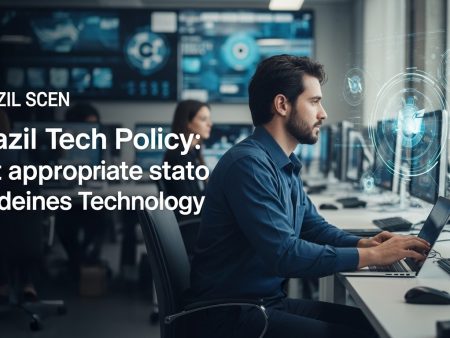
An in-depth, balanced look at how flavio Technology Brazil and AI-driven HR tools are shaping Brazil’s tech landscape, from policy and data governance to.
braziltechtoday.comBrazil tech news and digital trends.
Brazil Tech Analysis: flavio Technology Brazil and AI in HR
Updated: April 8, 2026
Across Brazil’s fast-evolving tech scene, flavio Technology Brazil has become shorthand for the intersection of public policy, corporate training, and AI-enabled HR tools that are starting to reshape payroll, recruiting, and workforce planning. This article examines how that convergence plays out in practice, what it means for businesses in Brazil, and how decision-makers can navigate the near-term challenges and opportunities.
Market Pulse
Brazil’s digital economy has expanded rapidly in the past five years, with e-commerce, fintech, and software-as-a-service driving growth in major urban centers and beyond. AI-enabled HR tools—ranging from automated screening to predictive workforce planning—are entering mainstream adoption more slowly, constrained by budget cycles, data governance concerns, and the need to integrate with legacy payroll systems. In this context, flavio Technology Brazil is not a single product but a way of framing a set of trends: Brazilian developers are building privacy-respecting AI, talent is increasingly comfortable with cloud-based software, and mid-market employers are testing small-scale pilots to measure ROI before wider rollouts. Beyond technology readiness, firms must contend with LGPD, which shapes how candidate data is stored, processed, and shared, and with a difficult talent market where skilled AI engineers are in high demand. The net effect is a cautious but growing appetite for HR tech that promises to streamline recruitment, onboarding, performance reviews, and compliance reporting without compromising user privacy.
Global Signals and Local Potential
Globally, investors are pouring capital into AI-powered HR platforms that promise to automate repetitive tasks, improve candidate matching, and provide analytics for people decisions. In the wake of high-profile funding rounds and strategic bets, Brazil sits at an inflection point: a large, young workforce, a mature consumer market for digital services, and an ecosystem of universities and accelerators that can supply local talent and experimentation grounds. While local regulatory and tax considerations add complexity, the success stories from other regions provide a blueprint for Brazil: partner with established players on data governance, run carefully scoped pilots focusing on measurable outcomes, and build solutions that can operate across multiple sectors such as manufacturing, retail, and healthcare. For Brazilian buyers, this means balancing cost and value, ensuring interoperability with existing HR systems, and prioritizing user experience to drive adoption across diverse teams.
Policy, Talent, and Practical Adoption
Policy frameworks and practical constraints shape the pace of adoption. Data privacy rules under LGPD require clear consent, data minimization, and robust access controls, making Brazil a setting where vendors must demonstrate strong governance and security. At the same time, the demand for skilled AI and data professionals continues to outpace supply, prompting corporates to invest in upskilling current HR staff and forming cross-functional teams that can translate technical capabilities into day-to-day HR workflows. Universities and private programs are expanding curricula in data science and machine learning; many firms choose to partner with local providers to tailor AI tools to Brazilian labor law requirements and payroll practices. The result is a pragmatic approach: deploy modular AI components, measure impact in controlled pilots, and scale only after validating improvements in time-to-hire, cost-per-hire, and employee engagement metrics. For Brazil’s mid-market, the challenge remains how to standardize data practices while preserving flexibility to customize processes for different industries and company sizes.
Actionable Takeaways
- Launch pilot programs in 3-6 mid-market companies to quantify time-to-hire reductions from AI screening and onboarding automation.
- Invest in upskilling HR teams with data literacy to maximize ROI from AI tools.
- Prioritize data governance and LGPD-compliant data handling with vendors; implement a modular, interoperable architecture.
- Encourage collaborations between Brazilian universities, startups, and corporates to test AI HR solutions in local contexts.
- Develop open standards for HR data to ease integration across payroll, talent management, and performance systems.
Source Context
From an editorial perspective, separate confirmed facts from early speculation and revisit assumptions as new verified information appears.
Track official statements, compare independent outlets, and focus on what is confirmed versus what remains under investigation.
For practical decisions, evaluate near-term risk, likely scenarios, and timing before reacting to fast-moving headlines.